01 — The brief
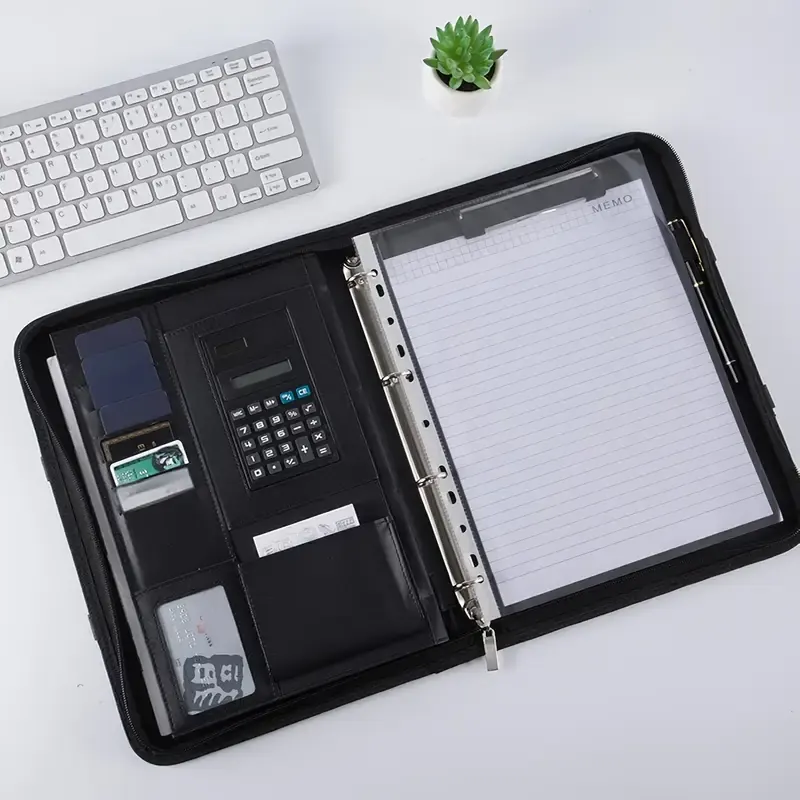
A European retail bank hands every newly certified advisor an onboarding kit: a portfolio, a notebook and a pen. The kits were being bought through a local print broker at a unit cost that made the L&D team wince, so they came to us to buy direct from the factory.
Four constraints came with the brief, and only the first one was about price:
- Colour had to survive comparison. The portfolio sits in the same box as the bank’s other branded items, so a visible colour mismatch is worse than a slightly wrong colour. Tolerance had to hold across 12,000 units and six production batches.
- Divider tabs in four languages — the programme runs in four countries and nobody wanted four SKUs.
- Phased delivery into four regional warehouses, each with its own intake date.
- No split kits. A portfolio without its notebook is not a kit; it is a complaint.
02 — The hard part
Round one failed, and it failed on colour. The first sample was approved from a photograph. The high-frequency welded PU was technically inside tolerance — ΔE 1.8 against the bank’s navy — but under the 3000K lighting in their office it read distinctly green. The problem was not the pigment. It was the surface finish: a satin topcoat reflects warmer light than a matte one, and the eye reads that reflection shift as hue. Two swatches can measure identical and look like different colours in the same room.
Round two failed on cold. The welded seam along the spine passed our own drop test at room temperature, then cracked at −5 °C. The bank’s Nordic warehouse is unheated in winter, and standard PU formulation goes brittle well before it reaches that temperature.
Round three exposed a smaller, more annoying failure. The divider tabs were printed on 300 gsm coated stock. Advisors flip those tabs dozens of times during training, and the tabs tore at the fold within weeks.
03 — What we built
Colour. We moved to a matte PU with a light-stabilised topcoat and stopped judging swatches under a single light source. Every approval now happens with the same swatch read under both D65 and a 3000K office lamp. The bank’s brand team signs off on the pair, not the photo.
The seam. We changed the welding die geometry rather than the material: widened the seam from 4 mm to 6 mm, moved it off the spine crease where the fold concentrates stress, and increased the dwell time by 3 seconds. That combination is what carried the seam through the −5 °C test — the wider, repositioned seam spreads the load, and the longer dwell gives the PU time to fuse properly instead of merely tacking.
The details. Dividers moved to 350 gsm with a laminated tab edge and a 2 mm radius on the tab corner — the radius is what stops the tear from starting. The pen loop became a stitched loop instead of a welded slot, because a welded slot cannot be replaced if it fails, and a stitched one can be re-sewn in our own workshop.
04 — Production
12,000 units across six runs, sized so that a failing batch would be caught before it became a failing shipment.
QC cadence: every 200th unit pulled for a seam-peel test and a colour read against the approved pair. Tab integrity checked by a 50-flip cycle on a sample from each run.
Delivery was phased DAP: four pallets to Rotterdam, two to Hamburg, one each to Malmö and Antwerp. Nothing shipped complete until all kit components were in our warehouse together — we would rather hold a pallet than send a portfolio without its notebook.
05 — Outcome
- Shipped inside the 38-day window across all four intake dates.
- Zero colour-rejection claims across six batches, once approval moved to the two-light-source method.
- The divider-tab tear that the bank had lived with from its previous supplier did not recur.
- The bank moved its next two regional programmes onto the same die, which is the outcome that actually matters — a repeat order means the first one was real.
What we would do differently: we would have insisted on a physical swatch before round one instead of approving from a photograph. That single shortcut cost nineteen days of sampling. It is now a rule on our side, not a preference.