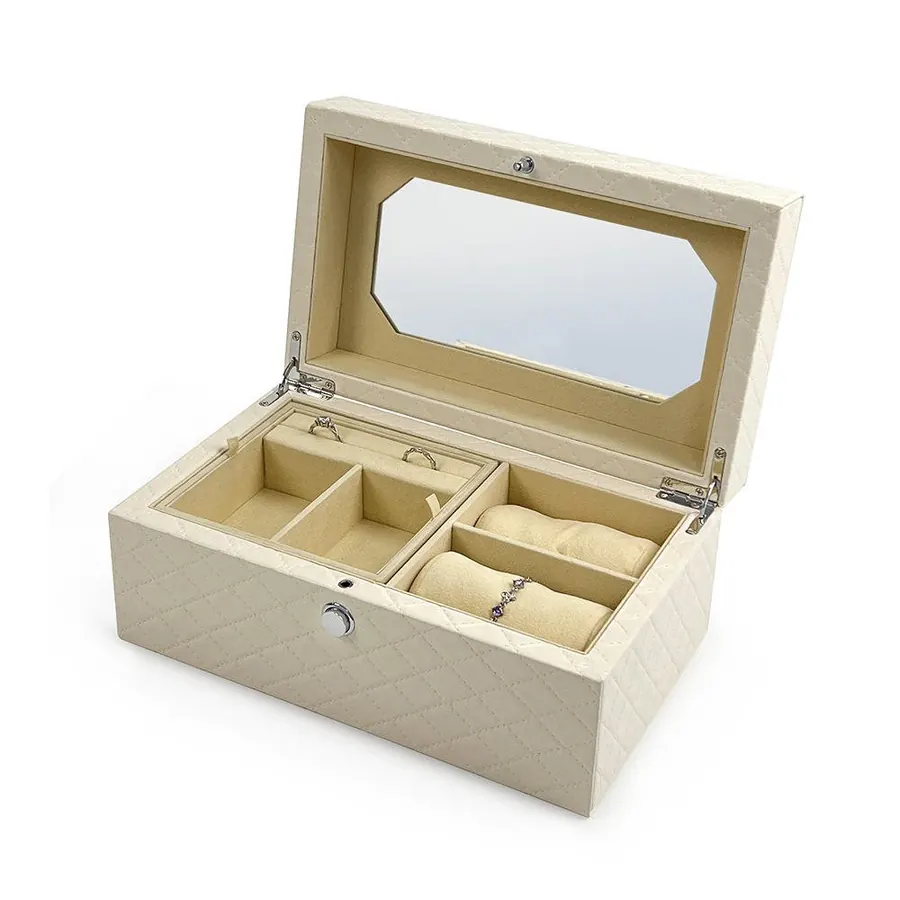
01 — The brief
A jewellery retailer sells watches in the €400–900 band. The watch arrives in a box the customer opens in front of the staff, and the box is the first thing they touch — before the watch. The retailer’s own words: “the box has to justify what is inside it, or the watch feels expensive for no reason.”
6,000 boxes, a hinged lid, a fitted insert, and a requirement that sounds trivial and is not: the lid must close with the same feel on box 1 and box 6,000.
02 — The hard part
Lid feel is a tolerance problem, not a design problem. A hinged presentation box has a very narrow band between two failure modes:
- Too loose, and the lid rattles when the customer lifts the box. It reads as cheap immediately.
- Too tight, and the lid will not seat itself; the customer has to press it, and the box looks defective on the counter.
The gap between those two is roughly 0.3 mm across a 180 mm lid — and that gap has to survive the natural variation of a wooden substrate, a PU wrap and a hinge.
First round: the lids rattled, and not because the hinge was wrong. The PU-wrapped wooden shell was coming in at the top of its thickness tolerance, so the lid sat fractionally high and the magnetic catch barely engaged. The hinge was fine; the substrate underneath it was not controlled tightly enough.
Second problem, found by accident. A box left on a sunny shop windowsill for a week showed the PU lifting at one corner. Wood moves with humidity; PU does not move with it.
03 — What we built
The shell. We moved the wooden shell to a machined, thickness-controlled substrate and held it to ±0.15 mm rather than relying on the mill’s default tolerance. This is the unglamorous fix that solved the rattle — the hinge geometry was never the issue.
The lid feel. Adjusted the magnetic catch to a defined pull-force range rather than “a magnet that fits”, and specified it as a measurable value the QC line can test with a spring gauge. If you cannot measure the feel, you cannot promise it across 6,000 units.
The lifting corner. Changed the adhesive to a moisture-tolerant formulation and added a wrap allowance so the PU is not under tension where the wood moves most. The corner stopped lifting in a repeat of the windowsill test.
The insert. Injection-moulded flocked insert, with the flock tested for fibre shedding — a black flock that sheds onto a watch face is a customer complaint that arrives with photographic evidence.
04 — Production
6,000 units over four runs.
QC: pull-force on every 100th box against the specification range; 24-hour humidity-cycle test on one box per run (the windowsill failure, turned into a routine); flock-shed tape test per batch of insert mouldings.
Delivered DDP so the retailer’s own intake team did not have to handle the customs paperwork for a packaging component — packaging arriving late delays the watches, and the watches are the revenue.
05 — Outcome
- Delivered in 31 days, ahead of the retail window.
- Lid pull-force stayed inside specification across all four runs — the first time this retailer had a supplier able to state the number, let alone hold it.
- No recurrence of the corner lift in the humidity test.
- The retailer extended the same box construction to two further watch lines.
The honest note: the rattle was not solved by anything clever. It was solved by controlling a dimension that everybody assumed was already controlled. Most disappointing packaging is like this — not a design failure, a tolerance failure that nobody measured.