Rigid Gift Boxes
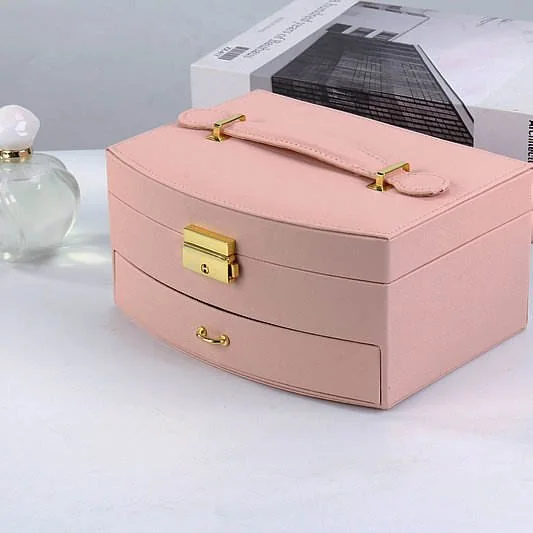
Double Layer Lock Drawer Type Jewelry Box Storage Box
A double-layer jewellery box with a drawer at the base and a lock. The drawer holds the pieces that are not in daily use while the top layer keeps everyday items accessible, and the lock secures both. It is the format specified where a box holds items of value and also sits somewhere accessible.
- Single-key lock
- Layered layout
- Lock type to spec
- Display-ready
| Material | Rigid greyboard wrapped in PU, paper or fabric, with EVA or suede inserts |
|---|---|
| Size | Made to your dimensions |
| MOQ | from 500 pcs |
| Lead time | 7–10 days sample · 25–35 days bulk |
Key data
Specs buyers ask first
| MOQ | 300 pieces portfolios · gift sets · sample books 500 pieces notebooks · ring binders · presentation packaging |
|---|---|
| Sample lead time | 7–10 days |
| Bulk lead time | 25–35 days |
| Quotation | Within one working day |
| Material | PU leather over rigid board · EVA or suede inserts |
|---|---|
| Imprint options | Foil stamping · debossing · screen print · metal badge |
| Artwork | Vector files (AI, EPS, PDF or CDR) |
| Size | Made to your dimensions |
What this one is
Locking box with a base drawer
The lock secures the lid and the drawer together, so a single key controls both. The top layer is laid out for pieces in regular use — rings on a roll, earrings on a tray — while the drawer below takes the rest, which keeps the display surface uncluttered without putting the remainder somewhere else. The lock type is a specification: a cam lock is the usual choice, with a keyed or combination option where several people need access. It is the arrangement used where a box is left on display rather than locked away.
- Single-key lock — One lock secures the lid and the base drawer together.
- Layered layout — Daily pieces on top, stored pieces in the drawer below.
- Lock type to spec — Cam lock, keyed or combination, chosen to the access requirement.
- Display-ready — Keeps the top surface uncluttered while retaining full storage.
Where it gets used
Who needs a lockable jewellery box
Retailers use locking boxes for counter stock that has to be reachable but not open to anyone passing. Hotels use them in rooms and suites where guests want valuables secured. Households use them where children or visitors have access to a dressing table. The lock is the reason for the purchase; the drawer and layer layout is what makes it usable day to day.
What we can change for you
Built around what goes inside it
This item is not picked off a shelf. Every part of it is specified before it is made, and these are the parts buyers change most often on a rigid gift boxes programme. Send whatever you have — a drawing, a photo of a sample you like, or a rough sketch — and we quote against it.
- Box construction — Two-piece lid and base, hinged lid, drawer, book-style flap or magnetic flip — rigid greyboard wrapped in the material you choose.
- Lining and inserts — EVA, suede, velvet, flocked or foam inserts cut to the product, with removable trays, ring rolls, watch pillows or dividers.
- Closure and hardware — Cam lock, magnetic closure, metal corner, ribbon pull, carry handle or hinges.
- Cover finish — PU leather, paper, fabric, wooden panels, acrylic windows or transparent lids.
- Branding — Foil stamping, debossing, screen print, metal badge or a printed inner lid.
- Retail packing — PVC inner bag, dust bag, printed sleeve, carton and pallet labelling to your forwarder specification.
Anything not on this list is a question rather than a no. We work from your artwork or a rough sketch, and cutting dies and covers are engineered in-house — so a change costs you a conversation, not a new supplier.
How your order is made
Tooling, printing and binding on our own line
Rigid boxes are wrapped and the inserts are cut in-house on servo-controlled presses. The insert is cut to your actual product rather than to a nominal size — that is what stops contents rattling in transit.
- Tooling and dies — cutting dies and covers are engineered in-house, so a change to the shape is a conversation rather than a new supplier.
- Printing and finishing — offset and screen printing, foil stamping, blind debossing, spot UV and edge painting all run on site.
- In-line QC — checks at cutting, stitching and packing, not only at the end. You get the inspection photos before the cartons close.
- Export and documentation — cartons, pallets, labelling and shipping documents prepared to your forwarder specification. 94.8% of what we make is exported.
Sampling
7–10 days
Production
25–35 days
Incoterms
FOB · CIF · DDP
Documents
one set per order
Factory audit report, material test reports and the pre-shipment inspection report are available on request — tell us which one your compliance team needs and we confirm it in writing.
How to order
From spec to shipment in four steps
Most buyers have a sketch, a sample, or a brief. We turn it into a confirmed sample and then into a repeatable production run.
Product type, dimensions, quantity, logo, and deadline — even a photo is enough.
Unit price, tooling, sample cost, and lead time — usually within one working day.
We make a physical sample for your review before anything goes to bulk.
In-line QC, pre-shipment photos, then packed and shipped to your forwarder.
Production & Quality
Built on our own line
Tooling, printing, finishing and packing all run in-house, so a change is a conversation rather than a new supplier.
Tooling and dies
Cutting dies and covers are engineered in-house, so a shape change is a conversation, not a new supplier.
Printing and finishing
Offset and screen printing, foil stamping, blind debossing, spot UV and edge painting all run on site.
In-line QC
Checks at cutting, stitching and packing, not only at the end. You get inspection photos before the cartons close.
Export packing
Cartons, pallets, labelling and shipping documents prepared to your forwarder specification.
Working with us
Files, tooling and terms
The same terms apply to this item and to the rest of your order, so the budget and the schedule can be planned before anything is committed.
- Artwork — Vector files (AI, EPS, PDF or CDR) are what embossing, foil and screen print need. A photo, a sketch or a physical sample is enough to start — we tell you before anything is charged if a file has to be rebuilt.
- Tooling — Charged only when the item needs a new mould, die or deboss plate. It is quoted separately and stated upfront — never added later.
- Samples — A stock sample is free (you cover the courier). A customised sample is chargeable and the cost is credited against the production order once it is confirmed.
- Payment — Invoiced in US dollars from our company account. Standard terms are T/T — 30% deposit, 70% before shipment — or an L/C at sight for container orders.
- Shipping — FOB Ningbo or Shanghai, CIF, and DDP to Europe and North America. DDP includes duties and final-mile delivery.
- Mixed containers — Several categories can ship in one container, which is how buyers keep the quantity per item down while still filling a shipment.
- Confidentiality — We sign an NDA before you send drawings.
- Documents — One inspection report and one set of documents cover the whole order, whatever the mix of items.
Buyer questions
What type of lock is fitted?
A cam lock is standard. Keyed and combination options are available depending on how many people need access.
Does one key open both the lid and the drawer?
Yes. The lock secures both sections together.
Can it be supplied without a lock?
Yes. The same box is produced without the lock if you do not need it.
Can the insert be cut to my product exactly?
Yes. Send the product, a sample or its exact outer dimensions and we cut the EVA or suede insert to that footprint. This is the single biggest cause of damaged returns on gift boxes, and it is decided before tooling, not after.
Do you make display boxes and storage boxes differently?
Yes, and we will tell you which one you actually need. A display box is judged on its lid and the way the product sits at an angle; a storage box is opened and closed for years and fails at its hinges and drawers.
Will silver tarnish inside the box?
Tarnish is a chemical reaction, not a polishing problem, and a closed box holds the materials that feed it. Tell us silver is going inside and we select linings and adhesives accordingly.
Which logo methods work on a wrapped box?
Foil stamping and blind debossing give the sharpest result on PU and paper-wrap. Screen print suits larger solid areas, and metal badges suit wooden and rigid lids.
How do you control colour between the box and the product?
We match the wrap, lining and foil to a physical master you approve — not to a screen. Keep one approved master per programme and the second run matches the first.
From our workshop notes
- Jewelry Storage by Tier: How Many Layers?
- Why Silver Turns Black in a Jewelry Box
- Why Watch Pillows Never Fit
Project record
A presentation box that has to justify the watch inside it
Request a quote
Send us the spec. We'll send a number.
Unit price, tooling cost and lead time — usually within one working day.
Request a quoteWhat to send us
- Product type and target dimensions
- Quantity — and whether it may grow
- Logo and artwork, even if rough
- Your delivery deadline and market